
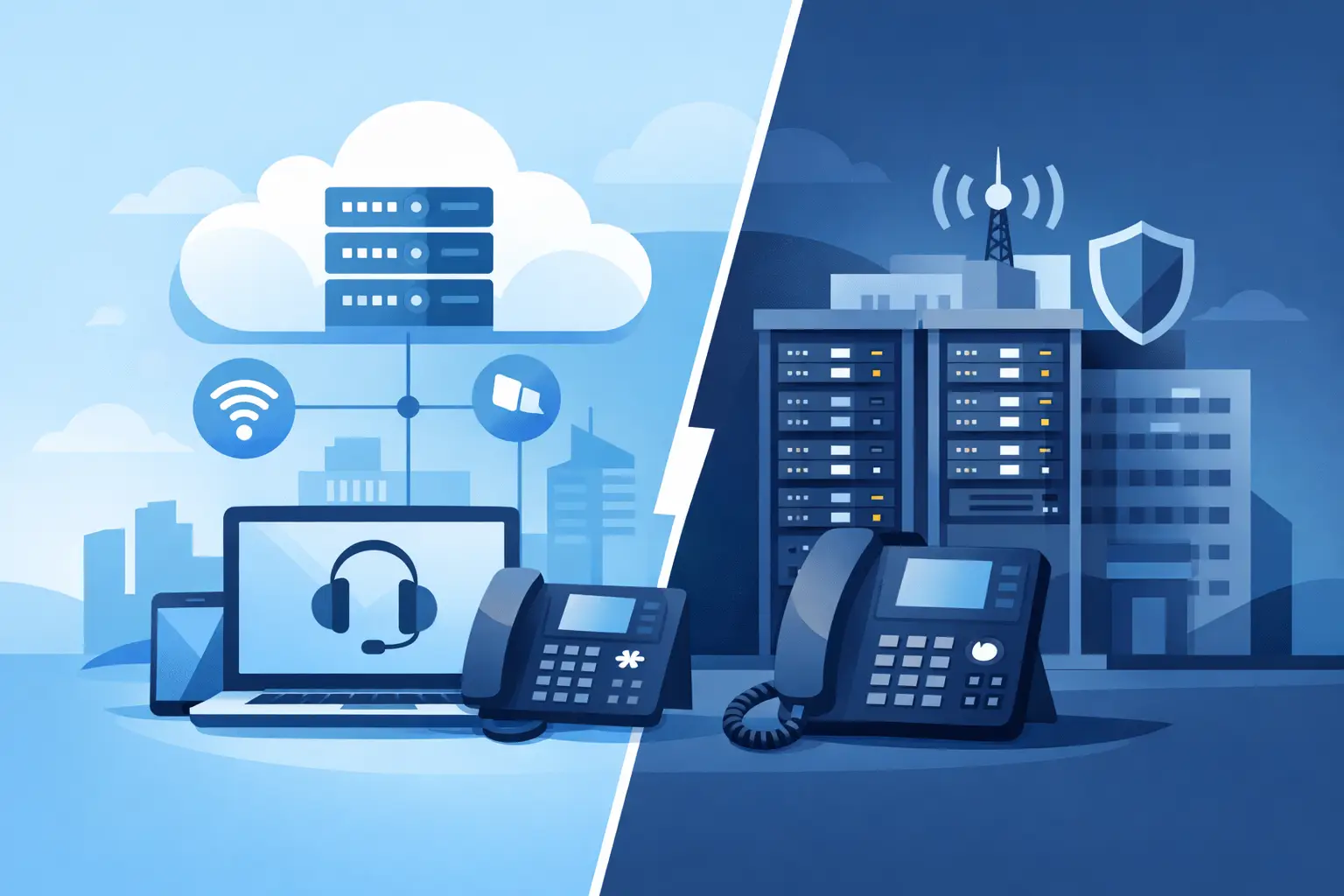
If your phone system still depends on aging hardware in a back room, the real cost is usually not the box itself. It is the downtime, the vendor delays, the limited reporting, and the friction your team feels every time the business needs to make a change. That is why hosted telephony vs on premise is no longer just an IT discussion. It is a business performance decision.
For many organizations, the right answer is not based on what they have always used. It comes down to how fast they need to move, how much internal support they have, what level of resilience they expect, and whether their communications platform can support customer experience goals instead of getting in the way.
Hosted telephony vs on premise: what is the difference?
Hosted telephony is a cloud-based phone system managed through a provider’s infrastructure rather than equipment you maintain at your office. Your users still have desk phones if needed, but they can also make and receive calls through desktop apps, mobile devices, softphones, and integrated business tools. Updates, hosting, and platform management are typically handled by the provider.
An on-premise phone system is built around PBX hardware installed and maintained at your location. Your business owns or leases the equipment, and your team or telecom vendor is responsible for upgrades, capacity planning, maintenance, and issue resolution. That model can still work well in some cases, but it places more operational responsibility on the customer.
At a glance, hosted telephony shifts the burden of infrastructure away from your business. On premise keeps more of that control in-house, but it also keeps more of the cost and risk there too.
Cost is usually the first filter
For most business leaders, budget starts the conversation. On-premise systems often require larger upfront capital expense. You may need PBX hardware, licensing, gateways, handsets, installation, cabling work, and periodic replacement as the system ages. Add maintenance agreements and service calls, and the total cost becomes much higher than the initial quote suggests.
Hosted telephony usually replaces that capital expense with a predictable monthly operating cost. That matters because it makes budgeting easier and reduces the financial risk of investing heavily in a platform that may not fit your business in three years. It also reduces the chance that one failed component creates an unplanned emergency project.
That said, lower upfront cost does not always mean lower long-term cost in every scenario. A very stable organization with little change, strong in-house telecom support, and a fully depreciated PBX may keep an on-premise system longer than expected. But for growing businesses, multi-location companies, and teams that need flexibility, hosted platforms often deliver a better financial outcome. In many cases, businesses can cut telephony costs significantly while gaining capabilities they did not have before.
Scalability changes the math quickly
A phone system should not slow down expansion. This is where the difference between hosted telephony vs on premise becomes practical very fast.
With on-premise systems, adding users, locations, or features can involve hardware limits, licensing constraints, technician visits, and longer deployment cycles. If your business is hiring, opening branches, supporting remote staff, or moving offices, every change becomes a project.
Hosted telephony is usually much simpler to scale. New users can be added faster, call flows can be adjusted without replacing infrastructure, and remote or hybrid employees can be brought into the same business phone environment without complicated workarounds. That flexibility is not just convenient. It supports growth, acquisitions, seasonal staffing, and business continuity planning.
For organizations that expect change, hosted is often the better fit because it grows with the company instead of forcing the company to work around the phone system.
Reliability depends on more than where the system sits
Some businesses assume on-premise means more reliable because the equipment is physically in their building. In practice, reliability depends on architecture, redundancy, carrier design, internet resilience, power continuity, and support quality.
An on-premise system can perform well, but it also creates a single-site dependency. If your office loses power, internet, or local hardware, your calling environment may be affected unless you have invested in backup systems and failover planning. Many companies do not realize how exposed they are until an outage happens.
Hosted telephony can provide stronger resilience when it is built on the right platform and supported correctly. Calls can often be rerouted, users can work from alternate locations, and mobile or desktop apps can keep teams connected if a physical office is unavailable. The key point is this: hosted does not automatically mean better uptime, and on premise does not automatically mean more control. The better question is which model gives your business the most practical continuity with the least internal burden.
Features matter when customer experience is on the line
Phone systems used to be judged mainly on dial tone. That standard is too low now. Business communications affect response times, customer satisfaction, team productivity, and management visibility.
On-premise systems can support advanced features, but they often require additional modules, custom programming, or outside vendor help. Over time, that can make even simple changes expensive or slow. If your team wants better reporting, smarter call routing, voicemail to email, CRM integration, IVR improvements, or AI-assisted call handling, an older PBX can become a bottleneck.
Hosted telephony platforms are generally better positioned for modern features because they are designed to evolve. That includes call reporting, multi-site routing, user-level controls, auto attendants, analytics, and AI-enabled automation that can improve how calls are answered and directed. For businesses trying to improve responsiveness without adding headcount, these tools can create real operational gains.
This is one of the biggest reasons many organizations move away from legacy systems. They are not just replacing phones. They are upgrading how the business communicates.
Management and support are often overlooked
A phone system is easy to evaluate when everything is working. The real test comes when your team needs changes, troubleshooting, training, or after-hours support.
On-premise systems often rely on a mix of internal IT, local telecom vendors, aging documentation, and hardware-specific knowledge that may no longer be easy to find. If one key person leaves, support gaps appear quickly. Even routine tasks can become slower than they should be.
Hosted telephony usually reduces that complexity, especially when it is backed by a provider that handles implementation, configuration, support, and optimization. That service model matters. A business-ready hosted solution should include more than phone lines. It should include design guidance, call flow planning, reporting, and responsive support that aligns with how your business actually operates.
That is where a consultative provider adds value. The platform matters, but the engineering and support behind it often matter more.
When on premise still makes sense
Hosted telephony is the better choice for many businesses, but not every business. There are cases where on premise still fits.
Organizations with strict site-specific compliance requirements, unusual legacy integrations, or highly customized local infrastructure may prefer to keep their PBX environment in-house. Some large enterprises also maintain on-premise systems because they have already invested heavily in internal telecom teams and supporting architecture.
Even then, the decision should be reviewed carefully. Many businesses stay on premise out of habit, not strategy. If the system is expensive to maintain, hard to scale, and difficult to support, keeping it may cost more than replacing it.
How to choose the right model
The best decision usually starts with operational goals, not product preference. Ask what your business needs from communications over the next three to five years. If you need to reduce telecom spend, support remote work, improve reporting, simplify management, or add smarter automation, hosted telephony will usually be the stronger option.
If your priority is preserving a specialized local environment and you have the staff and budget to maintain it properly, on premise may still be viable. But that choice should be made with a clear view of future cost, flexibility, and support risk.
For many US businesses, the most practical path is to assess the current system honestly. Look at outages, support delays, feature gaps, and the cost of every move, add, or change. Then compare that with a hosted model designed around uptime, scalability, and measurable savings. Providers such as Voice2IP approach that review as a business improvement project, not just a phone replacement.
The right phone system should make growth easier, service stronger, and costs more predictable. If it does not, it may be time to stop maintaining yesterday’s setup and choose a platform built for what your business needs next.