
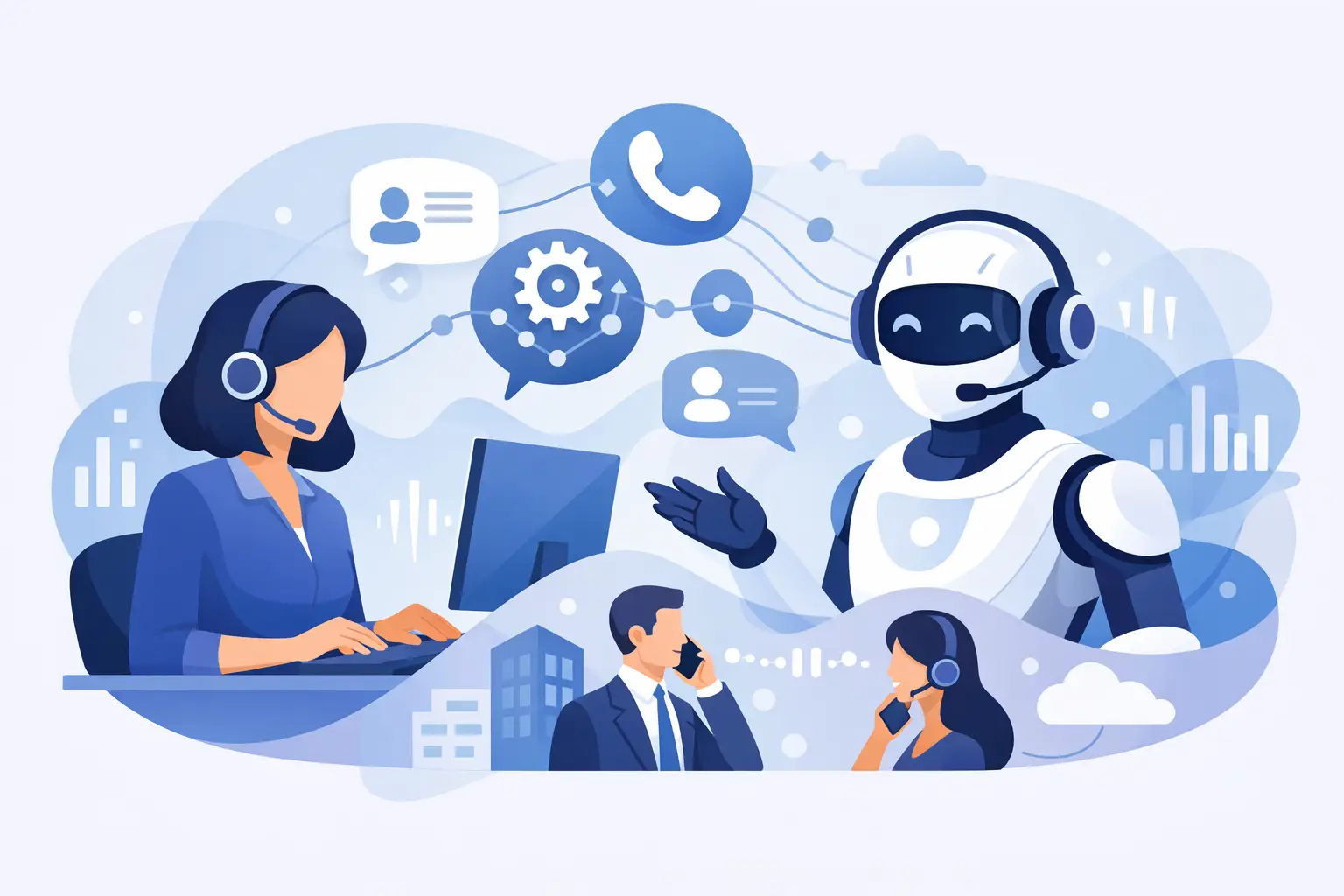
A customer calls at 8:03 a.m. to check an order status. Another calls at 8:04 with a billing issue. A third wants sales, but reaches the wrong extension and hangs up. That kind of pileup happens every day, and it is exactly where businesses start asking how AI improves call handling in a practical, measurable way.
The short answer is that AI helps businesses answer faster, route smarter, reduce manual work, and give staff better information during live conversations. But the real value is not just speed. It is consistency, visibility, and the ability to handle more calls without adding the same level of overhead.
How AI improves call handling in real operations
Most companies do not have a call problem. They have a workflow problem that shows up on the phone.
Calls come in without enough context. Teams rely on manual transfers. Peak times expose staffing gaps. Agents spend too much time on repetitive questions. Managers have limited reporting on why calls are missed, how long callers wait, or where transfers break down. AI addresses those issues at the system level.
Instead of treating every call the same, AI can evaluate caller intent, past interactions, time of day, queue conditions, and business rules before deciding what should happen next. That can mean routing a VIP customer to a priority queue, sending common support requests through automated self-service, or presenting the employee with caller details before they even say hello.
This matters because better call handling is not only about customer experience. It affects labor efficiency, conversion rates, service levels, and telecom costs. For businesses trying to grow without letting communications become a bottleneck, AI is a practical upgrade.
Faster answers without adding headcount
One of the clearest reasons businesses invest in AI telephony is capacity. When call volume rises, the old answer was usually more reception staff, more agents, or more overflow frustration. AI changes that equation.
An AI-enabled phone system can answer every inbound call immediately, gather the reason for the call, and direct it to the right destination. For routine requests, it may resolve the issue without involving an employee at all. For more complex needs, it can shorten the path to the right person instead of sending callers through a generic menu tree.
That does not mean replacing your team. It means protecting your team from low-value repetition so they can focus on the calls that need judgment, empathy, or sales skill. A business that fields the same appointment, payment, or location questions all day can recover a surprising amount of staff time by automating the front end of those interactions.
There is a trade-off here. If automation is poorly designed, it can frustrate callers just as quickly as an outdated IVR. The difference is in the implementation. AI works best when call flows are built around real business needs, with easy paths to a live person when needed.
Smarter routing improves first-call resolution
A large share of phone inefficiency comes from avoidable transfers. The caller selects the closest menu option, reaches the wrong person, explains the issue, gets transferred, repeats the issue, and starts forming a negative opinion of the business.
AI improves this by interpreting natural language and routing based on intent, not just keypad choices. If a caller says they need to reschedule service, report an outage, or speak with accounts receivable, the system can identify that request and route accordingly. In more advanced deployments, AI can also use CRM data, account status, or historical interaction patterns to improve the decision.
The business impact is straightforward. Fewer transfers reduce handle time. Better routing improves first-call resolution. Employees spend less time redirecting calls and more time solving problems. Customers feel like they reached a competent organization instead of a maze.
Better support for live agents
AI is not limited to what happens before a person answers. Some of the biggest gains happen during the call.
When integrated properly, AI can provide real-time prompts, pull relevant customer details, surface knowledge base answers, and generate call summaries after the interaction ends. That reduces note-taking, shortens wrap-up time, and helps staff stay focused on the conversation.
For managers, this creates a more consistent service model. Newer employees can perform with more confidence because the system supports them with relevant information. Experienced staff can move faster because they are not hunting across separate tools for order history, prior tickets, or internal process documents.
This is especially useful in businesses where a phone call is tied to revenue or service continuity. Sales teams benefit when AI helps identify intent and prioritize hot leads. Service teams benefit when the system captures context and reduces repeat explanations. Operations teams benefit when reporting shows where bottlenecks are happening.
Reporting becomes a management tool, not a guess
Many businesses still manage phone performance with partial data. They know the phone rings. They know some calls get answered. Beyond that, they are guessing.
AI-enhanced call handling produces better data because more of the interaction is captured, categorized, and measured. Managers can see call reasons, peak demand periods, transfer patterns, abandonment trends, agent response times, and recurring customer issues. That makes it easier to adjust staffing, refine call flows, and fix service gaps before they become expensive habits.
It also supports accountability. If one department is overloaded while another has spare capacity, reporting makes that visible. If callers are dropping off at a certain point in the process, it becomes easier to redesign the experience. Better call handling starts with better decisions, and better decisions require better information.
Cost control is part of the value
Businesses often evaluate AI through the lens of innovation, but the financial case is just as strong.
When AI reduces unnecessary transfers, repetitive call handling, missed calls, and after-call admin work, it lowers the cost per interaction. When it is paired with a hosted VoIP environment, businesses can also reduce telecom spend, simplify administration, and avoid the cost burden of maintaining legacy systems.
That does not mean every company should automate aggressively from day one. The right model depends on call volume, call complexity, service expectations, and internal workflows. A medical office, field service company, manufacturer, or multi-location business will each have different priorities. The point is that AI should be applied where it creates measurable gains, not added for its own sake.
For many organizations, the best starting point is not a full replacement of existing processes. It is improving the highest-friction parts of call handling first: after-hours coverage, front-end call triage, appointment requests, overflow management, and reporting.
Where AI works best and where human handling still matters
AI is strongest when calls are frequent, patterns are repeatable, and speed matters. It is highly effective for routing, qualification, simple requests, and queue management. It is also valuable for supporting agents and improving visibility across the phone environment.
Human teams still matter most when conversations involve emotion, negotiation, exception handling, or complex decision-making. A frustrated customer, a sensitive HR issue, or a high-value sales opportunity should not be trapped in automation. Good call handling is not about removing people. It is about using people where they create the most value.
That balance is what separates a productive phone system from a frustrating one. Businesses get the best results when AI and human support are designed together, not treated as separate layers.
What to look for in an AI-enabled phone system
If you are evaluating providers, focus less on feature lists and more on outcomes. Ask how the system will reduce missed calls, improve routing accuracy, support your staff, and fit your current workflows. Look for implementation guidance, reporting, reliability, and ongoing support, not just software access.
This is where a service-led provider matters. The technology alone does not fix call handling. The real improvement comes from call flow design, integration planning, tuning, and long-term support. A platform that can grow with your company is far more useful than a phone system that simply adds another layer of complexity.
Voice2IP works with businesses that want more than dial tone. The goal is to reduce telecom costs, improve performance, and build a communications environment that supports growth instead of slowing it down.
If your phone system still depends on manual transfers, missed opportunities, and limited reporting, AI is not a future concept. It is a practical way to make every call easier to manage, easier to measure, and more valuable to the business.