
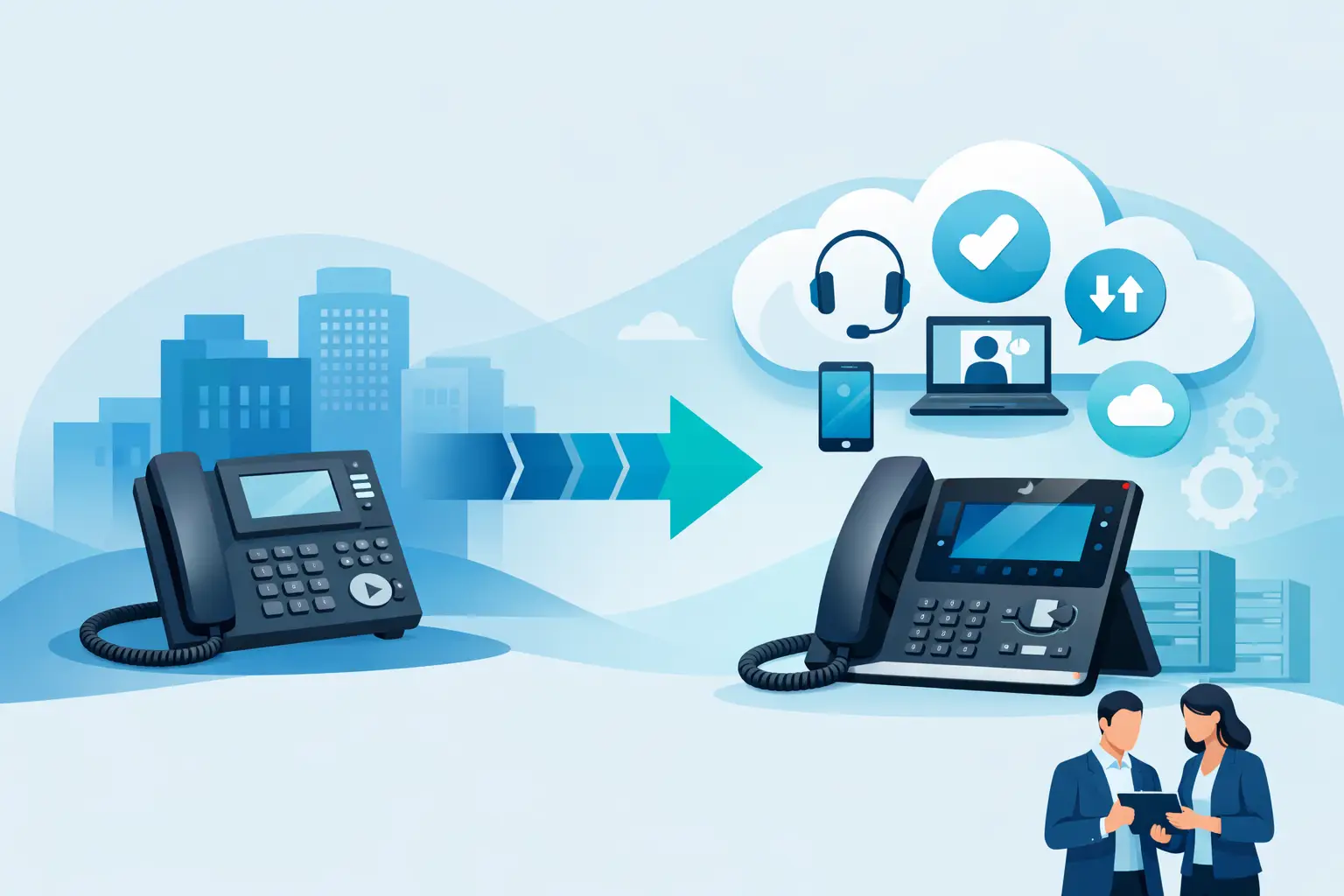
A bad cutover shows up fast. Calls drop, departments lose direct numbers, the help desk gets flooded, and leadership starts asking why a phone project turned into an operations problem. That is why enterprise phone system migration is not just a technical task. It is a business continuity project with direct impact on customer experience, staff productivity, and telecom spend.
For larger organizations, the real challenge is rarely the new platform itself. It is the move from a legacy PBX, aging PRI circuits, scattered analog lines, or a patchwork of carriers and locations into a system that is easier to manage and more cost-effective. When the migration is planned correctly, companies can save up to 50% on telephony costs while gaining better reporting, stronger call routing, and room to scale.
What an enterprise phone system migration actually involves
At the enterprise level, migration usually means more than replacing desk phones. It often includes number porting across multiple sites, redesigning call flows, consolidating carriers, mapping departments and hunt groups, integrating with contact centers or CRM tools, and making sure remote and on-site users can work without disruption.
There is also a governance side that gets overlooked. Security policies, E911 requirements, call recording rules, failover planning, and user permissions all need to be reviewed before any change goes live. If those items are treated as afterthoughts, the project gets expensive quickly.
The best migrations start with a full inventory. You need to know what numbers exist, where they terminate, which lines support alarms or faxing, which teams depend on call queues, and what business hours or routing rules are in place today. Many companies discover they are paying for lines, features, or vendor contracts nobody really wants to keep.
Why enterprises migrate in the first place
Most organizations do not begin an enterprise phone system migration because they want a newer phone on a desk. They move because the current environment is holding the business back.
Legacy systems are expensive to maintain. Parts are harder to source, support contracts keep rising, and every move, add, or change takes too long. Reporting is often limited, which makes it difficult for operations leaders to measure call performance or staffing needs. Expansion becomes painful too. Opening a new location or supporting hybrid teams should not require a separate telecom project each time.
There is also a customer experience issue. Modern business communications platforms make it easier to route callers correctly, reduce hold times, provide self-service through IVR, and support AI-enabled call handling where it makes sense. That does not replace live service. It improves how calls are triaged so staff can focus on higher-value conversations.
For many businesses, cost reduction is the first trigger, but flexibility becomes the bigger long-term benefit. Once communications are easier to manage, teams stop working around the system and start using it to improve performance.
How to plan an enterprise phone system migration without disruption
The safest migrations are phased and structured around business risk. That starts with defining what success actually means. For one company, success may be reducing monthly telecom costs. For another, it may be centralizing multiple offices under one managed platform with stronger reporting and 24/7 support. Usually it is both.
Start with the call flow, not the hardware
Many migrations go sideways because too much attention goes to handsets and not enough to how calls move through the business. Before choosing configurations, map the customer journey and internal call routing. Which departments need direct inward dialing, which teams need queue logic, and where are calls currently abandoned or transferred too often?
This is where a migration becomes an improvement project instead of a like-for-like replacement. Rebuilding a flawed call structure on a new platform just gives you newer technology with the same old bottlenecks.
Audit carriers, circuits, and numbers early
Number porting can be simple or messy depending on how your environment was built over time. Enterprises often have numbers spread across multiple providers, billing entities, or regional offices. Some numbers may be tied to old contracts, while others support critical services such as fax machines, fire panels, or elevator lines.
A detailed audit early in the process prevents last-minute surprises. It also creates an opportunity to eliminate waste. Many organizations find duplicate services, unused lines, or outdated contracts that can be removed as part of the migration.
Segment users by business need
Not every department uses the phone system the same way. Executives, front desk staff, call-heavy support teams, sales groups, remote workers, and warehouse or field users all have different requirements. Treating everyone the same usually creates adoption issues.
A better approach is to build user profiles based on workflows. Some users need advanced call handling and analytics. Others need a simple softphone and mobile app. The right migration design supports both without forcing the entire company into one model.
Common risks in enterprise phone system migration
The biggest risk is assuming migration is just a porting and provisioning exercise. It is not. The hard part is managing dependencies across locations, teams, and business processes.
Downtime is the obvious concern, but poor cutover timing can create softer problems that last longer. If training is weak, users will flood internal support channels. If auto attendants are not tested thoroughly, callers will hit dead ends. If failover routing is not in place, even a short internet issue can become a customer service incident.
There are trade-offs too. A fast migration can reduce project fatigue, but it increases pressure on testing and change management. A phased rollout lowers risk, but it may require temporary coexistence between old and new systems. The right choice depends on your number of locations, operational complexity, and tolerance for change.
Testing should reflect real business conditions
Basic dial-tone testing is not enough. Enterprises need scenario-based testing that reflects actual call volumes and workflows. That means validating inbound routing, transfer behavior, voicemail delivery, queue performance, after-hours logic, mobile access, and failover paths.
If your business has compliance or recording requirements, those functions should be tested with the same rigor. The goal is not to confirm the system works in a lab. The goal is to confirm it works on a busy Monday morning.
What to expect from the right migration partner
A provider should do more than activate service. At the enterprise level, you need design guidance, implementation control, carrier coordination, user provisioning, call flow configuration, and post-cutover support. You also need honest advice on what to keep, what to retire, and where automation will actually help.
That matters because not every feature creates value. AI-enabled telephony can improve routing, deflect repetitive calls, and speed up basic caller interactions. But it needs to be applied carefully. If automation makes it harder for customers to reach the right person, it hurts service instead of improving it.
The right partner focuses on outcomes: lower monthly costs, stronger uptime, easier administration, cleaner reporting, and a communications environment that can grow with your company. That is the difference between buying another phone system and investing in a business communications platform.
For organizations with multiple sites or complex call handling, experienced implementation support is often what determines whether the project feels controlled or chaotic. Voice2IP approaches migration from that practical angle, combining hosted VoIP, configuration, call flow design, AI options, and ongoing support so the business gets a system it can actually use.
After cutover, the real work begins
A successful go-live is not the finish line. It is the point where your team starts learning what the new system can do. Reporting should be reviewed early so managers can identify missed calls, queue issues, and staffing trends. Admin controls should be documented so internal teams can handle routine changes without opening unnecessary tickets.
This is also the right time to keep optimizing. Many companies migrate for cost reasons, then realize the bigger gain comes from better call routing, more responsive customer handling, and less friction for staff. Those improvements happen after launch, when the system is tuned to real usage.
If you are considering enterprise phone system migration, treat it as an operations decision, not just an IT refresh. The right plan protects continuity on day one, lowers telecom costs over time, and gives your business a communications platform built for growth rather than maintenance.