
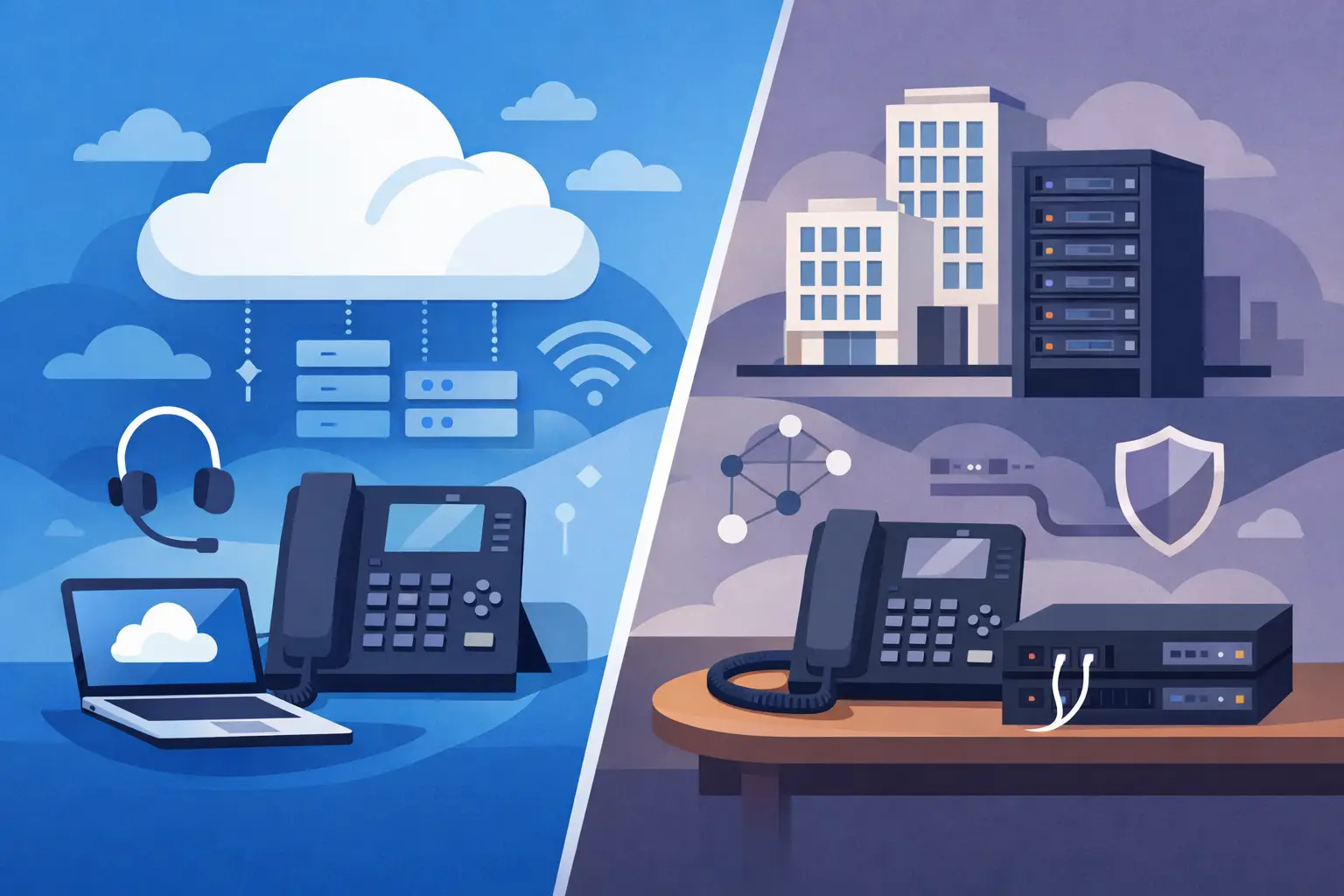
A phone system decision usually gets forced by a problem. The PBX is aging out. Support is slow. Adding users takes too long. Reporting is limited. Or your business has simply outgrown a setup that was fine five years ago. When companies compare cloud pbx vs on premises options, they are rarely choosing between two equal paths. They are choosing between two different operating models.
That distinction matters. One model keeps infrastructure in your building and puts more responsibility on your team. The other shifts the platform to a hosted environment and turns telephony into a managed service. Both can work. The better choice depends on how your business handles growth, support, security, uptime, and cost over time.
Cloud PBX vs On Premises: The real difference
An on-premises PBX is a phone system your business owns and maintains on-site. That usually means hardware in a server room or telecom closet, local configuration, and some level of dependency on internal IT or outside telecom contractors. For some organizations, especially those with highly specific legacy requirements, that level of control still has value.
A cloud PBX, by contrast, is hosted off-site and delivered as a service. Your phones, softphones, call routing, IVR, reporting, and administration are managed through an online platform rather than tied to a box in your office. You still control the business rules and user experience, but you do not carry the same hardware burden.
For most growing businesses, that shift changes more than where the system lives. It changes how fast you can scale, how easily you can support remote teams, how often you can improve call flows, and how much internal effort the system consumes.
Cost is not just the purchase price
A lot of buyers start with capital expense versus monthly operating expense. That is a reasonable place to begin, but it is not enough.
An on-premises system may look less expensive after the initial investment is paid off. The problem is that the true cost rarely stays confined to the original hardware. There are software licenses, maintenance agreements, replacement parts, PRI or SIP service, technician callouts, upgrade projects, backup power considerations, and the labor involved in managing changes. If your team needs better call reporting, more advanced IVR, or multi-site flexibility, those additions can become separate projects with separate costs.
A cloud PBX usually moves those expenses into a predictable monthly model. That can feel higher on paper if you compare it only to a depreciated legacy system. But businesses that look at the full picture often find the hosted model reduces telecom spend while also lowering the support burden. For decision-makers focused on efficiency, that is the key point. Lower cost means more when it also removes friction.
This is where a service-led provider can make a measurable difference. The right hosted design can help businesses save up to 50% on telephony expenses, but only if the system is configured around actual business needs rather than sold as a generic seat package.
Control versus agility
Some companies favor on-premises PBX because they want direct control over the environment. That can make sense in organizations with deep internal telecom expertise, highly customized infrastructure, or strict internal policies around where systems are managed.
But control comes with overhead. If every change requires internal resources, specialist knowledge, or a ticket to a third-party vendor, control can quickly become delay. Adding a location, adjusting hunt groups, changing business hours routing, or launching a new IVR menu should not turn into a week-long task.
Cloud PBX gives most businesses more practical agility. Admins can make common changes quickly. Providers can handle more advanced configuration. New users, remote staff, and temporary teams can be added without the same hardware constraints. For companies opening new offices, supporting hybrid work, or dealing with seasonal demand, that flexibility is often more valuable than owning the system outright.
Reliability depends on more than where the PBX sits
There is still a common assumption that an on-premises phone system is more reliable because it is physically present in the office. In practice, that is only true if the office itself is more resilient than the hosted environment supporting a cloud platform.
An on-premises PBX can be vulnerable to local power failures, internet outages, hardware faults, and building-level disruptions. You can design around some of those issues, but each safeguard adds cost and complexity. Redundancy is possible, but it is not free.
A well-designed cloud PBX typically benefits from hosted redundancy, failover options, and easier call continuity during local office issues. If a site loses power, staff may still be able to take calls on mobile devices, laptops, or alternate locations. That business continuity is not a bonus feature anymore. For many organizations, it is a baseline requirement.
Reliability also depends heavily on support. A phone system is only as dependable as the people responsible for keeping it available and resolving issues fast. This is one reason many businesses move away from legacy systems. They are not just replacing hardware. They are replacing a slow support model.
Features that affect growth
When businesses compare cloud pbx vs on premises, feature checklists can be misleading. Both systems may support basic calling, voicemail, auto attendants, and extensions. The more useful question is how easily those features can be improved and expanded.
On-premises platforms often become limited by version, hardware, or integration complexity. If you want advanced reporting, AI-enabled call handling, CRM integration, smarter call routing, or a better IVR experience, the path may involve add-ons, custom work, or platform replacement.
Cloud systems are generally better positioned for ongoing improvement. Features like call analytics, recording management, dynamic routing, softphone mobility, multi-location administration, and AI-assisted workflows are easier to deploy in a hosted environment. That matters because business communications no longer stop at dial tone. The phone system now affects customer experience, agent performance, and operational visibility.
For companies trying to improve responsiveness and efficiency, the question is not whether the phone rings. The question is whether the system helps the business perform better.
Security and compliance are not one-size-fits-all
Security concerns are often raised in favor of on-premises systems because they feel more contained. In some environments, especially highly regulated ones with unusual compliance demands, local control may still align better with policy.
That said, many businesses overestimate the security advantage of keeping a PBX on-site. A system sitting in a closet is not automatically more secure than a professionally managed hosted platform. It still needs patching, monitoring, access control, and proper configuration. If those disciplines are inconsistent, local ownership can create risk rather than reduce it.
Cloud PBX security depends on provider quality, architecture, and operational discipline. For most small and midsize businesses, a strong hosted provider will deliver better day-to-day telephony security and system maintenance than an understaffed internal team can provide on its own.
The right decision comes down to your actual requirements, not assumptions. If compliance, retention, and call recording rules are central to your operation, those factors should be reviewed early, not treated as a late-stage technical detail.
Which businesses still choose on-premises?
On-premises PBX can still be the right fit for organizations with unusual legacy equipment dependencies, highly specific local integrations, or internal telecom teams that want full administrative ownership. It may also appeal to businesses that have already invested heavily in infrastructure and are not yet ready to transition.
Even then, the decision should be examined carefully. Many companies stay on old systems not because on-premises is truly better, but because migration feels disruptive. In reality, the bigger risk is often waiting too long and getting trapped by unsupported hardware, expensive repairs, and a system that cannot keep up with the business.
Which businesses benefit most from cloud PBX?
Cloud PBX is usually the stronger fit for businesses that want to reduce telecom overhead, support hybrid or multi-site teams, improve customer call handling, and scale without buying more hardware. It is especially effective for organizations that want a communications platform that can grow with the company instead of being replaced every few years.
That includes small businesses that need professional call routing without enterprise complexity, mid-sized companies that need centralized administration across locations, and larger organizations that want reporting, automation, and responsive support from a partner that knows business telephony inside and out.
For many of those companies, the biggest advantage is not technical. It is operational. They stop spending time managing a phone system and start using it more effectively.
The better question to ask
Instead of asking which system is better in theory, ask which model best supports the way your business runs now and where it is headed next year. If your priorities are flexibility, lower support burden, faster changes, stronger continuity, and room for AI-enabled automation, cloud PBX will usually come out ahead. If your environment has narrow requirements that truly demand local control, on-premises may still be justified.
The strongest outcomes usually come from reviewing the current system honestly – costs, failure points, user frustration, support gaps, and missed opportunities. That is where a provider like Voice2IP can add value, not by pushing a phone line replacement, but by designing a communications system that supports growth, improves customer interactions, and cuts unnecessary spend.
A phone system should not be something your team works around. It should be something your business can build on.