
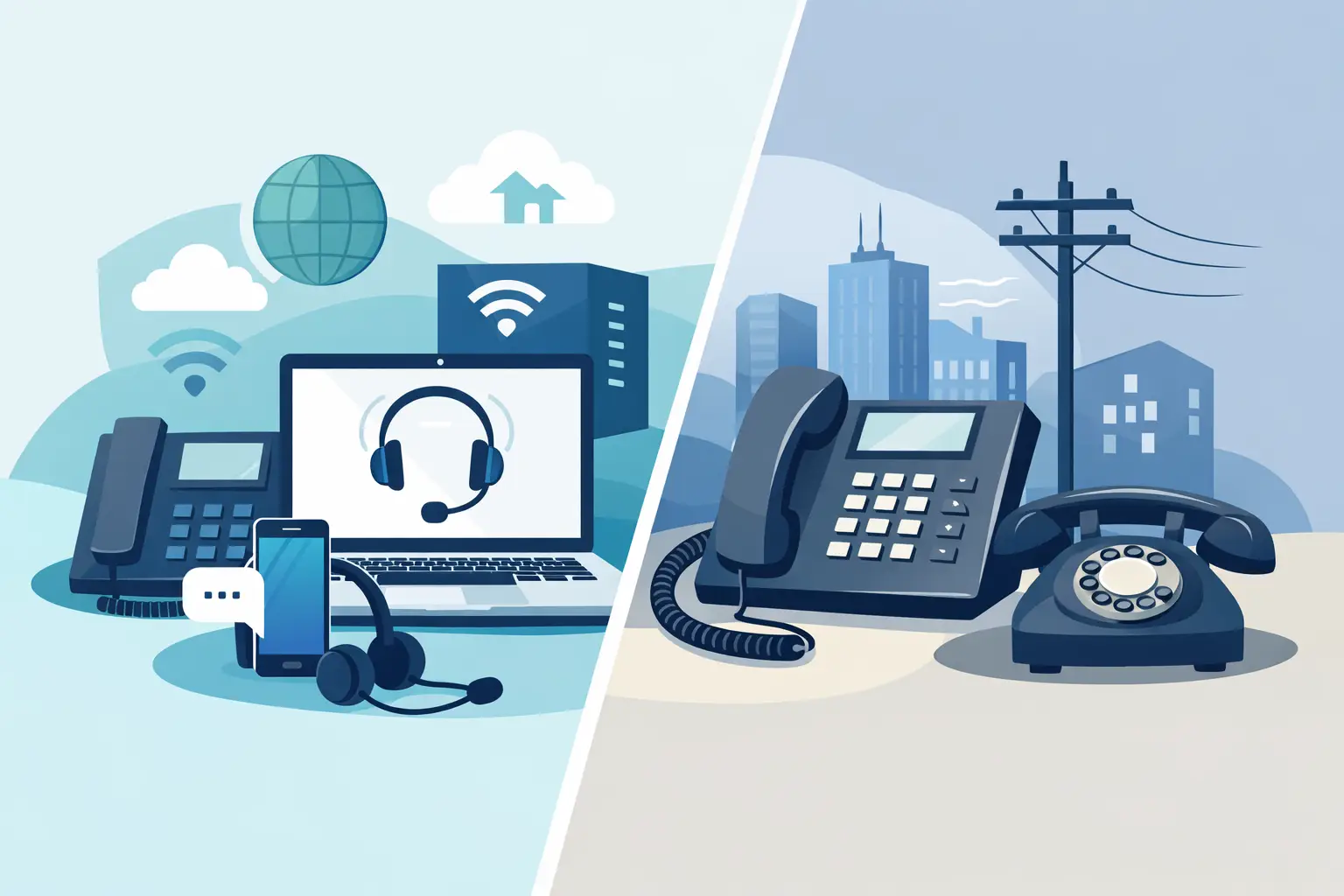
If your team is still juggling an aging desk phone system, rising carrier bills, and limited visibility into call performance, the voip vs landline business question is no longer theoretical. It is a budget decision, an operations decision, and in many cases a customer experience decision.
For some organizations, a traditional landline still has a place. But for most growing businesses, the real issue is whether an older phone setup can keep up with how modern companies operate – across offices, remote teams, mobile users, and higher expectations for reporting, automation, and support.
VoIP vs landline business: what is the real difference?
A landline business phone system typically runs on copper-based phone lines or legacy carrier infrastructure. It is familiar, stable in the narrow sense, and often tied to physical locations, fixed hardware, and service models that have changed very little in years.
VoIP, or Voice over Internet Protocol, routes calls over your internet connection instead of traditional phone lines. For a business, that changes more than the transport method. It affects how easily you can add users, move locations, support hybrid work, build call flows, monitor performance, and control monthly costs.
That is why this comparison is not just about dial tone. It is about whether your phone system supports the way your business actually works.
Cost is usually the first tipping point
Landline systems often look predictable on paper, especially for businesses that have used the same provider for years. But the total cost tends to climb when you factor in line charges, hardware maintenance, carrier service fees, technician visits, long-distance costs, and the expense of making even small changes to the system.
VoIP usually reduces those costs because the infrastructure is more flexible and the service model is more centralized. Adding an extension does not usually require the same level of on-site work. Moves, adds, and changes are faster. Multi-site businesses can avoid paying for disconnected systems in each location. In many cases, companies can save up to 50% compared with legacy telephony setups, especially when they are replacing older PBX environments or multiple carrier contracts.
That said, the cheapest option is not always the best option. If a low-cost VoIP provider offers little implementation support, weak call quality management, or slow issue resolution, the savings can disappear quickly. Business communications should be evaluated on total operating value, not just the monthly line item.
Reliability depends on the setup, not just the label
One reason some businesses hesitate to leave landlines is reliability. The assumption is simple: landlines are dependable, internet-based calling is risky. That belief made more sense years ago than it does now.
A well-designed hosted VoIP system with proper network readiness, failover planning, quality-of-service configuration, and responsive support can deliver excellent uptime and call quality. In many cases, it can outperform aging on-premise systems that rely on old hardware and carrier infrastructure with limited flexibility.
Landlines do still offer an advantage in one narrow scenario: they can remain operational during certain local power or internet outages, depending on the exact setup. But businesses rarely operate on voice alone anymore. If your CRM, email, cloud apps, and customer service tools are all internet-dependent already, keeping a landline for perceived continuity does not solve the broader continuity issue.
The better question is whether your communications provider can design resilience into the system. That includes call forwarding rules, mobile continuity, backup routing, and support that responds when something breaks.
Features are where the gap becomes obvious
This is the point where landline systems usually start to show their age.
Most businesses no longer need only basic calling. They need auto attendants, ring groups, after-hours routing, voicemail to email, call recording, user-level controls, detailed reporting, softphones, mobile apps, and the ability to support remote and in-office users without creating separate systems.
VoIP platforms are built for this. They can also support more advanced tools such as IVR design, call analytics, CRM integration, and AI-enabled call handling. That matters if you want to reduce missed calls, improve routing, shorten response times, or give managers visibility into how the phone channel is performing.
A landline system can sometimes be patched together to provide parts of this functionality, but it is usually harder, more expensive, and less adaptable. Businesses end up paying to preserve a system that still cannot deliver what newer platforms handle by default.
Scalability matters more than most teams expect
A five-person office can live with limitations longer than a 50-person operation. But growth has a way of exposing every weakness in a phone system.
With landlines, expansion often means new physical lines, hardware changes, carrier coordination, and more friction when opening offices or supporting distributed staff. Even seasonal changes can become operationally annoying if the system was not built for flexibility.
VoIP scales much more naturally. You can add users, departments, direct numbers, and new locations without rebuilding the whole environment. That flexibility is one of the biggest reasons businesses move away from legacy systems. They do not want a phone platform that has to be re-argued every time the company changes shape.
For leadership teams, that translates into faster execution. You can onboard new staff more quickly, support remote work without workarounds, and avoid communications delays when the business is trying to move.
Customer experience is often the deciding factor
Many phone system decisions are framed as IT or telecom decisions. In practice, they are customer experience decisions.
A landline system can take calls. It may even do that reliably. But can it route callers intelligently? Can it give customers the right options based on time of day, department, or business rules? Can supervisors see where calls are being missed or delayed? Can it support overflow logic during peak periods? Can it help reduce the burden on front-desk staff?
VoIP platforms make these improvements possible because they are designed as business communications systems, not just phone lines. Better routing, stronger reporting, and smarter automation can directly improve conversion rates, service levels, and staff productivity.
That is particularly important for businesses that rely on inbound calls for sales, scheduling, service requests, or account support. If the phone channel is part of revenue generation, the system should be measured by outcomes, not nostalgia.
When a landline still makes sense
The voip vs landline business decision is not one-size-fits-all.
A very small office with minimal call volume, no growth plans, and limited need for advanced features may be fine with a basic landline arrangement for now. The same can be true for sites with poor internet reliability and no practical path to improve connectivity in the near term.
There are also cases where a business keeps a small number of analog lines for backup, alarms, elevators, or specific operational requirements while moving the main user base to VoIP. That hybrid approach can be practical during a transition.
The mistake is assuming that keeping landlines is the safer choice by default. In many organizations, it simply delays the shift while costs continue to rise and functionality stays limited.
What businesses should evaluate before switching
Before replacing a landline system, decision-makers should look beyond the brochure features. The quality of the migration matters as much as the platform itself.
Start with network readiness. If your internet connection, internal network, or Wi-Fi setup is weak, fix that first. Then assess call flows, departments, user roles, remote work needs, compliance requirements, and any integrations that affect operations.
Support should be a major part of the decision. A provider that can design, implement, configure, and manage the environment will usually create a better long-term result than one that simply ships phones and leaves the rest to your staff. This is where a service-led partner such as Voice2IP can make a measurable difference, especially for organizations that want cost savings without sacrificing reliability or growth potential.
The better question is not which is newer
The better question is which system helps your business operate more efficiently next quarter and next year.
If your current landline setup is limiting visibility, slowing down changes, increasing telecom costs, or making customer interactions harder to manage, that is your answer. A modern VoIP system is not just another phone system. Done properly, it becomes part of how your business reduces overhead, supports employees, and handles customers more effectively.
Technology choices should earn their place by improving outcomes. If your phone system cannot do that anymore, it may be time to stop treating it like a utility and start treating it like a growth platform.